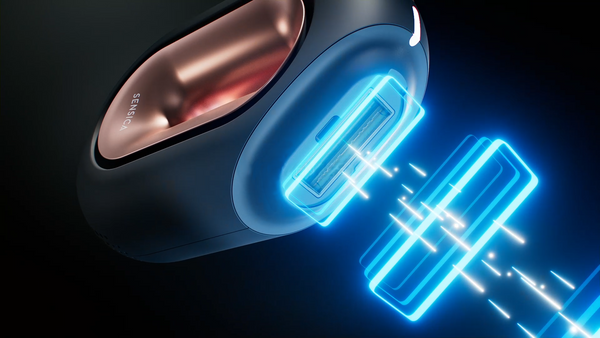
It's a Tuesday evening, you're scrolling through your phone, and you're feeling incredibly tired of your shaving routine (and honestly, who isn't). You've been researching at-home hair removal. You know the clinical-grade ones like the Sensilight Pro or the Sensilight Mini are investments. Suddenly, the algorithm serves you a perfectly targeted ad for a device that looks incredibly sleek. It comes in a cute pastel color. It promises the exact same miraculous results. And the best part? It's only 99 dollars.
It feels like a massive win. You think to yourself that the beauty industry is just marking up prices, and you've finally found the clever shortcut. Why spend hundreds of dollars on a premium device when this little pink handset claims to do the exact same thing?
When you look at the clinical studies and engineering standards that separate a medical-grade device from a generic gadget, the truth becomes very clear. When you buy a "budget" device, you aren't getting a clever shortcut. You're buying a plastic shell that lacks the internal hardware required to actually do the job. And the only thing more expensive than a premium device is buying a cheap one, getting absolutely zero results, throwing it into the back of your bathroom drawer in frustration, and then eventually buying the premium one anyway - we call this the beauty device graveyard.
Let's open the hood and look at the engineering components you're actually paying for when you invest in clinical-grade technology.
The false economy of beauty dupes
In the beauty world, we love a good dupe. If a drugstore lip gloss gives you the exact same shine as a high-end designer brand, buy the drugstore version. If a more affordable moisturizer has the exact same hyaluronic acid concentration as the luxury cream, save your money. In those scenarios, you're often paying for packaging, a brand name, and fragrance.
Beauty tech operates on an entirely different level than topical skincare. You aren't buying a cream that sits on the surface of your skin. You're buying a machine designed to permanently alter your hair follicles or stimulate your deep dermal layers using concentrated thermal energy.
When a company builds a 99-dollar IPL device, they aren't taking a loss out of the goodness of their hearts. They're aggressively cutting manufacturing costs. And in the world of thermal physics, the only way to cut costs that drastically is to remove the very components that make the device safe and effective.
You end up with a device that looks like a laser, sounds like a laser, and flashes a bright light. Structurally, however, it's closer to a toy flashlight than a medical tool.
Component one: The Capacitor (the eart of the machine)
If there's a beating heart inside an IPL device, it's the capacitor.
Think of a capacitor like a bucket that holds electrical energy. When you press the treatment button on your device, the capacitor tips over and dumps all of that stored energy into a powerful, controlled burst of light or heat. Once the burst is fired, the capacitor has to instantly refill itself from your wall outlet or battery before it can fire again.
High-quality capacitors are incredibly expensive to manufacture. They're bulky, heavy, and require precise engineering to ensure they don't overheat or degrade over time. A clinical-grade device like the Sensilight Pro has a capacitor capable of delivering an exact, consistent burst of energy every single time you press the button. Whether it's your first flash on day one, or your fifty-thousandth flash two years later, the energy output is identical.
Budget devices use incredibly cheap, tiny capacitors. What could possibly go wrong? The first flash you trigger might be strong enough. Because the cheap capacitor can't refill fast enough, though, the second flash is slightly weaker. The third flash is even weaker. By the time you're running the device over your second leg, the energy output has plummeted.
You end up sitting on your bathroom floor, dutifully gliding the device over your skin, thinking you're getting a great treatment. In reality, you're essentially just shining a warm reading light on your leg. Without consistent, powerful energy delivery, the hair follicle never absorbs enough heat to actually shut down. This lack of consistent, powerful energy delivery is exactly why clinical reviews of low-fluence home devices often show poor or temporary hair reduction compared to devices built to professional standards. The machine simply doesn't have the engine to push the car up the hill.
Component two: adaptive sensors (the brains of the operation)

The single most important safety feature on an at-home IPL device is the skin tone sensor. This isn't a luxury upgrade. It's an absolute, non-negotiable necessity.
Because IPL technology targets melanin (pigment), it needs to know exactly how much pigment is in your skin versus how much pigment is in your hair. Premium clinical devices like the Sensilight Mini and Sensilight Pro are built with advanced sensors that physically lock the device from flashing unless there is full, tight contact with your skin. And if the sensor detects that a patch of skin is simply too dark to be safely treated, it refuses to flash. It actively protects you from getting hurt.
The Sensilight Pro takes it a step further with a dedicated setting that acts like a highly trained technician. When you use it, the sensor takes a reading of your specific melanin levels and suggests the exact energy output you should use for that patch of skin. It doesn't hijack the controls and change things automatically. Instead, it empowers you with the correct data so you can set the device with complete confidence.
A 99-dollar device doesn't have an adaptive skin tone sensor - it can't afford one.
Instead, it relies on you to guess. It asks you to look at a small, poorly printed color chart on the back of the cardboard box, and holding your arm up to the bathroom light, guess which color block matches your skin.
When it comes to targeted thermal energy, guessing is a terrible strategy. Your skin tone isn't uniform across your entire body. If you guess incorrectly and set the dial too high, the melanin in your skin will absorb the light energy instead of the hair follicle. That results in pain and burns.
The Reality of the Beauty Device Graveyard
The beauty industry often blames consumers when a home device goes unused. The standard explanation is that we lack discipline or give up too easily. But every successful habit relies on a psychological feedback loop: you put in the effort, and you receive a clear reward. When you start using an IPL device, the effort is high. You have to shave, prep your skin, and spend twenty minutes carefully treating your legs. If you're using an underpowered budget device, weeks go by without any visible change to your hair growth. The effort remains high, but the reward never arrives.
Without that positive feedback loop, your brain simply stops prioritizing the chore. The device gets pushed to the back of the drawer, and you go back to your razor. You haven't failed a test of willpower. You experienced a broken feedback loop caused by hardware that couldn't deliver on its promises.
This is exactly why clinical-grade engineering matters for your routine, not just your skin. When a device has the power to deliver actual, visible hair reduction within the first few weeks, it closes the feedback loop. You don't have to force yourself to keep using it, because seeing the results provides all the momentum you need.